

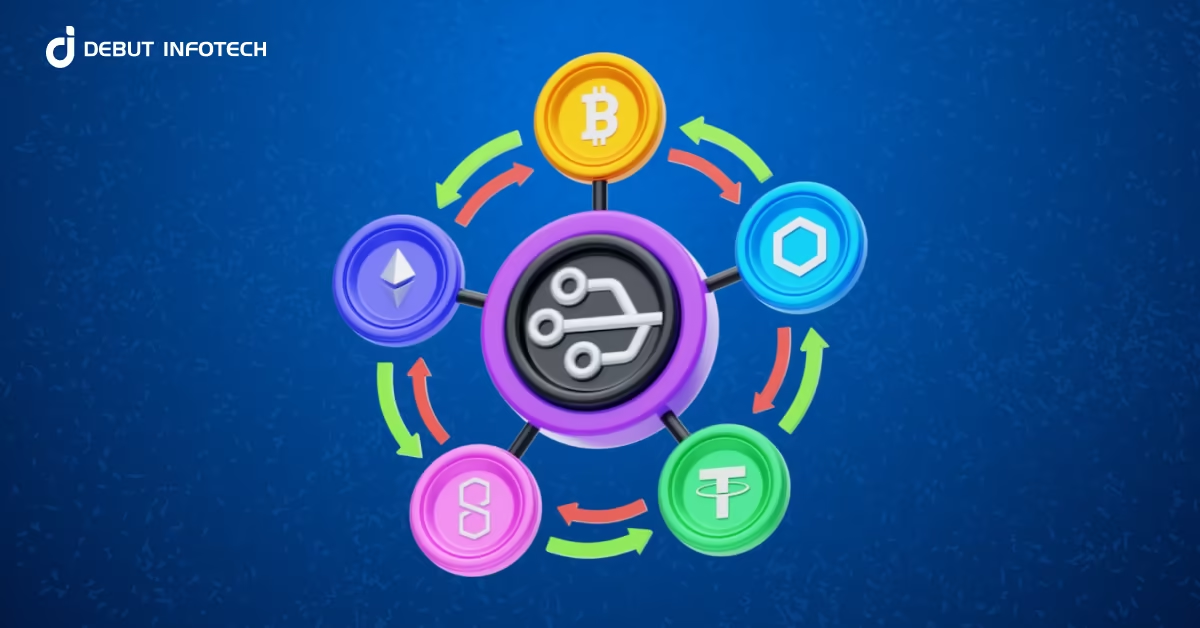
For years, crypto traders have been split between two worlds: the convenience of centralized exchanges (CEXs) and the freedom of decentralized platforms (DEXs). Both ecosystems dominated at different times—CEXs captured mainstream adoption, while DEXs powered the DeFi boom. But now, something new is emerging from the gaps between them.
A third category is quietly rising, one that blends the best features of both: Hybrid Exchanges.
What started as an experimental concept is quickly becoming one of the most talked-about developments in the trading landscape. And if trends continue, hybrid exchanges may not just coexist—they may become crypto’s new default standard.
Let’s break down why.
The Problem: CEX vs. DEX Is No Longer a Useful Debate
For years, the industry tried to frame crypto trading as a choice:
- Centralized Exchanges:
Fast, liquid, beginner-friendly—but with custodial risk, regulatory pressure, and censorship concerns. - Decentralized Exchanges:
Transparent, permissionless, user-controlled—but often lacking speed, liquidity, and polished user experiences.
Both sides had advantages, and both had clear limitations.
But as the market matured, traders started wanting both sets of benefits in a single platform.
Hybrid exchanges are stepping into that space with a simple promise:
“Why choose one when you can have both?”
What Exactly Is a Hybrid Exchange?
A hybrid exchange (HEX) is a platform that merges:
- CEX-level performance
(high throughput, deep liquidity, instant order execution)
with
- DEX-level autonomy
(self-custody, transparent on-chain settlement, non-custodial security).
Think of it as a CEX front-end with a DEX engine—or vice versa.
This model lets traders keep control of their assets while still accessing professional-grade infrastructure. And that balance is reshaping expectations across the industry.
The Driving Force: Traders Want Control and Performance
1. Self-Custody Is Becoming Non-Negotable
Events like FTX reminded the world that even the largest exchanges hold points of failure.
Users now care deeply about:
- proof of reserves
- secure custody
- transparency of operations
- control over private keys
Hybrid exchanges directly respond to this new mindset by allowing traders to maintain ownership of their assets while using centralized-like interfaces and tools.
2. But Traders Still Want Speed and Reliability
No matter how decentralized the technology becomes, one thing remains true:
Speed matters. Liquidity matters. Ease-of-use matters.
DEXs still struggle with:
- front-running
- slippage
- congested networks
- slower execution speeds
Hybrid exchanges address this through off-chain or layer-2 order matching, allowing them to process trades at lightning speed.
Regulation Is Also Pushing the Shift
The global shift toward regulatory clarity is forcing crypto platforms to modernize. CEXs face increasing compliance obligations, while pure DEXs face scrutiny around accountability, AML, and user protections.
Hybrid exchanges offer a middle ground:
- Regulated access points
- Transparent on-chain settlements
- Optional KYC models
- Better alignment with emerging global rules
This model is appealing to institutions and compliant retail users—two groups driving the next major wave of adoption.
The Technology Behind Hybrid Exchanges Is Finally Ready
Early attempts at hybrid exchanges were limited by blockchain constraints. But now, several breakthroughs are changing that:
Layer-2 scaling solutions
Enable low fees and fast settlement.
Off-chain order books with on-chain settlement
Allow high performance without sacrificing autonomy.
Advanced MPC and smart contract wallets
Give users full control without the friction of self-managing private keys.
Cross-chain liquidity networks
Reduce fragmentation, making hybrid models more efficient and appealing.
The technical foundations that hybrid exchanges needed for years are now fully mature—and the timing couldn’t be better.
Institutions Are Quietly Paying Attention
Big money wants:
- compliance
- transparency
- execution quality
- risk management
- auditability
Hybrid exchanges check all the boxes.
Instead of choosing between completely centralized or fully decentralized infrastructure, institutions can now operate within familiar regulatory frameworks while still benefiting from blockchain’s transparency.
Many institutional desks see hybrid models as the most logical long-term architecture for crypto markets.
Why Hybrid Exchanges Could Become the New Standard
If you follow the evolution of crypto infrastructure, the trend becomes clear:
✔ People want self-custody
✔ Markets need high-speed execution
✔ Regulators want transparency and compliance
✔ Institutions want safe, scalable environments
✔ Users want smooth interfaces and low fees
Hybrid exchanges happen to meet all of these needs simultaneously.
That’s why this model may soon eclipse both traditional CEXs and pure DEXs—and establish itself as the next generation of exchange tech.
The Big Picture: This Is Crypto Growing Up
Hybrid exchanges represent a simple truth:
Crypto trading is evolving beyond ideological battles and moving toward practical, scalable solutions.
The industry is no longer choosing between decentralization and convenience.
It’s finally learning how to merge them.
And as the pressure for speed, transparency, compliance, and user protection grows, hybrid exchanges may not just be an alternative—they might be the inevitable future.
The foundations are already being laid.
The adoption curve is starting to push upward.
And the exchanges that adapt early will define the next decade of crypto trading.
